Will AI Replace Pharmacy Technicians?
No. AI automates repetitive pharmacy tasks like data entry and refill processing, but technicians remain essential. Here's what's actually changing.
No. AI automates the repetitive, rules-based parts of a pharmacy technician’s day, data entry, refill processing, insurance checks, label printing, not the technician. Clinical judgment, exception handling, and patient counseling still require a person, and pharmacies that automate well are scaling volume without cutting technician headcount, not the other way around.
Why this question keeps coming up
Pharmacies are visibly automating right now. Prescription volumes keep climbing, staffing is tight, and technicians are watching software take over tasks they used to do by hand: e-prescription entry, faxed order transcription, refill authorizations. It’s a reasonable question to ask what’s next.
The short version: automation is going after the tasks that are high-frequency and low-complexity, exactly the kind of work that’s tedious for a person and where fatigue-driven mistakes creep in. It is not going after the judgment calls.
What AI actually automates today
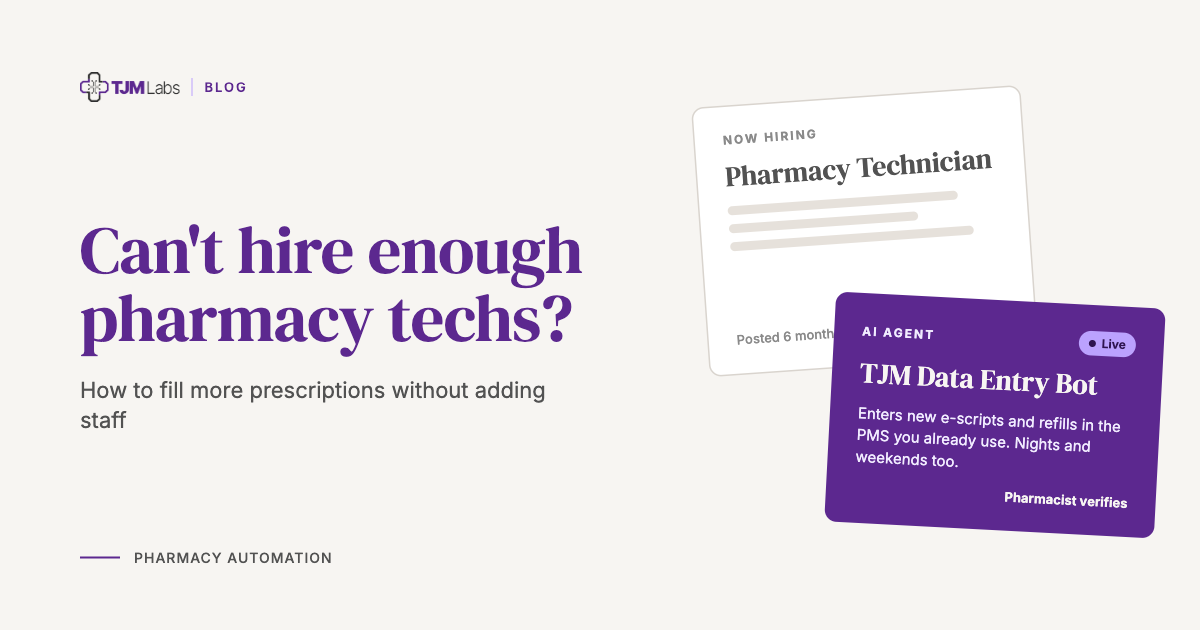
AI agents built to work inside a pharmacy’s existing management system (no new platform, no API integration) can:
- Enter e-prescriptions and transcribe faxed or handwritten orders
- Run refill authorization and insurance/coverage checks
- Update patient demographics across systems
- Generate labels and documentation once an order is verified
These are the tasks that eat technician time without requiring technician judgment. Removing them doesn’t remove the technician. It removes the queue of repetitive clicks between the technician and the parts of the job that actually need a person.
What still needs a technician
Automation doesn’t handle clinical checks, patient counseling, or the exceptions that don’t fit a standard workflow: a prescription with an unusual interaction flag, a patient with a complicated insurance situation, a judgment call on how to handle a borderline case. Those go to a person, same as before. What changes is how much of the technician’s day is left over for that work once the repetitive volume is handled elsewhere.
How TJM Labs approaches this
TJM Labs pairs a pharmacist with an engineer on every implementation, the Dual-Expert Model™. The pharmacist defines what the AI should and shouldn’t touch, based on real pharmacy workflows and safety protocols; the engineer builds the automation to work inside the pharmacy’s existing software, the way a technician already does. Nothing goes live without both sides signing off.
Carepoint Pharmacy is a concrete example of what that looks like in practice: AI agents took over prescription data entry, insurance billing, coupon processing and prior authorization work, and instead of eliminating positions, Carepoint moved seven full-time employees into higher-value roles. In their own words, automation “allowed us to reallocate our labor into other departments that needed the help.” Capacity grew, and the technician team didn’t shrink to get there.
That direction matches the broader labor picture, too: the U.S. Bureau of Labor Statistics projects roughly 7% growth in pharmacy technician jobs from 2023 to 2033, faster than the average occupation, hardly the trajectory you’d expect if automation were displacing the role rather than reshaping it.
FAQs
Will AI replace pharmacy technicians?
No. AI takes over repetitive, rules-based tasks, data entry, refill processing, label printing, but it doesn’t replace clinical judgment, exception handling, or patient-facing work. Pharmacies using automation well are scaling prescription volume without cutting technician headcount.
Will AI take over pharmacy technician jobs?
Not the jobs themselves, the repetitive portion of them. Technicians who work alongside automation typically spend less time on administrative tasks and more time on patient interaction, clinical support, and managing the automation’s exceptions.
How is the pharmacy technician’s role changing because of AI?
Technicians are spending less time on manual data entry and more time on work that needs a person: patient counseling, clinical support, and overseeing the automation itself, reviewing flagged exceptions and cases the AI routes for human judgment.
Curious what this looks like for your pharmacy specifically? Talk to our team.