Where Pharmacies Actually Gain Efficiency in Prescribing
Prescribing efficiency gains show up at specific points in the workflow, intake, benefit checks, refills, communication, not everywhere at once.
“AI makes prescribing more efficient” isn’t specific enough to act on. The real efficiency gains show up at particular points in the workflow, and it matters which ones, because that’s what determines whether an automation investment actually shows up in your numbers or just sounds good in a pitch.
Intake and data entry
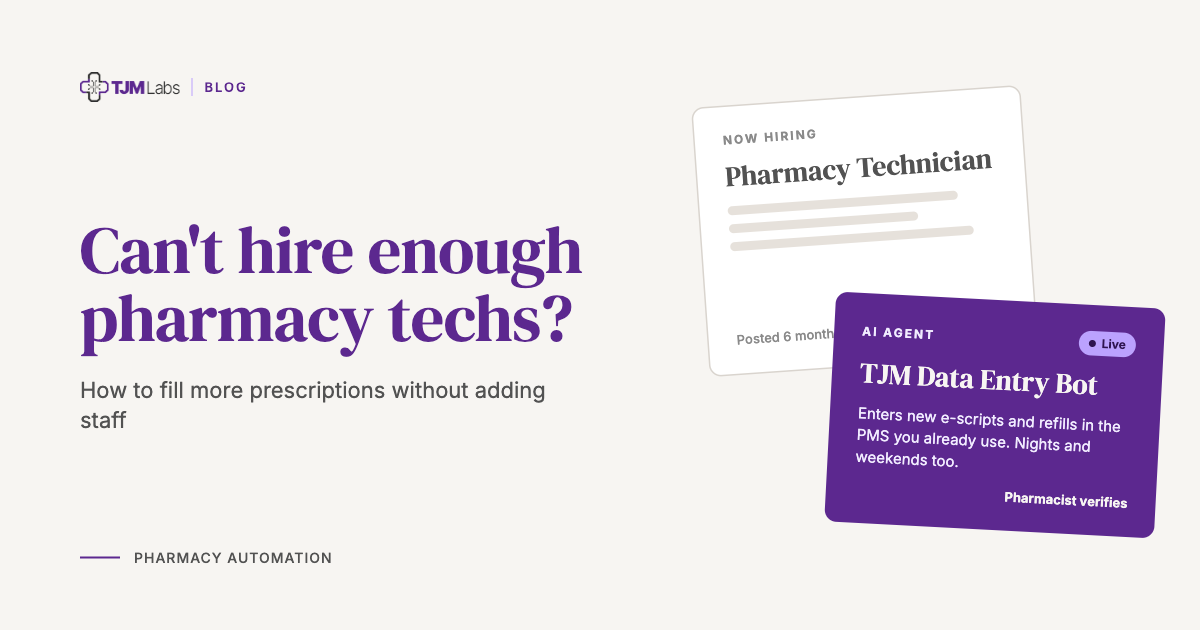
This is where the clearest, most measurable gains show up, because it’s the most repetitive part of the workflow. At LinkRx, a specialty compounding pharmacy, 8 automation bots now process 6,640 prescriptions daily, an outcome the pharmacy’s Director of Operations described as replacing what used to require multiple shifts of technicians. For retail pharmacies specifically, out-of-the-box automation cuts data entry hours by 75% and reaches positive ROI within the first month, because there’s no custom workflow build required.
Benefit investigation and insurance checks
Checking coverage and running benefit investigations is manual, repetitive, and easy to automate against a PMS the same way data entry is, but it’s a distinct workflow stage with its own efficiency gain, separate from intake. This matters most for specialty pharmacies, where benefit investigations are a recurring, high-friction step for every new prescription rather than a one-time setup.
Refill and order processing
Refill authorization and order processing is where volume efficiency compounds. LinkRx, a specialty compounding pharmacy, reached 6,640 prescriptions per day with a 10x return on its automation investment, a level of throughput that isn’t reachable by adding headcount at the same cost.
Patient communication
This is a separate efficiency gain from anything happening in the PMS itself. Zeal Specialty Pharmacy’s AI voice agent handles 82% of patient calls, with 50% fully resolved without staff involvement, freeing technician and pharmacist time that would otherwise go to routine refill and status calls, not prescription processing itself.
Where it doesn’t show up
Clinical judgment calls, exception handling, and patient counseling aren’t efficiency gains from automation. They’re the parts of the job that still require a person, and that’s intentional. The efficiency gain is in removing everything around those decisions, not the decisions themselves. Pharmacies that expect automation to touch clinical judgment are optimizing for the wrong stage of the workflow.
Why the stage matters more than the tool
A pharmacy evaluating automation should ask which specific stage a tool targets, not just “does it use AI.” Intake automation and patient-communication automation solve different problems and show up in different numbers. A pharmacy drowning in refill calls won’t see much benefit from a data-entry tool, and vice versa. TJM Labs’ Dual-Expert Model™ exists specifically to map automation to the stage where a given pharmacy is actually losing time, rather than applying a generic tool everywhere.
FAQs
Where do pharmacies actually see efficiency gains from automation?
At specific workflow stages: prescription intake and data entry, benefit investigation and insurance checks, refill/order processing, and patient communication. Each is a separate gain. A tool built for one doesn’t automatically help with another.
Does prescribing automation save time on clinical decisions?
No, and it shouldn’t try to. Clinical judgment, exceptions, and patient counseling still require a pharmacist or technician. The efficiency gain comes from removing the repetitive work around those decisions, not replacing the decisions.
How much efficiency can a pharmacy actually expect from automation?
It depends on the workflow stage and pharmacy type. Real examples: a specialty compounding pharmacy processing 6,640 prescriptions daily through automation, a retail pharmacy cutting data entry hours by 75%, and a specialty pharmacy resolving half its patient calls without staff involvement.
Want to know where your pharmacy would see the biggest gain? Talk to our team.