AI in Pharmacy and the Evolving Role of the Pharmacy Technician
AI is reshaping pharmacy workflows, reducing administrative burden, and elevating the role of pharmacy technicians. Learn how automation improves accuracy, reduces burnout, and empowers techs to focus on higher-value patient care.
The Growing Challenge
Pharmacies today are under immense pressure. Prescription volumes are surging due to an aging population and chronic diseases, while staffing shortages make it harder to keep up. This workforce crunch means existing pharmacy technicians are stretched thin by administrative work, like transcribing prescriptions, processing refills, updating records, and juggling insurance claims.
Traditional manual workflows simply cannot scale to meet demand; they drain time, increase burnout, and open the door to errors. One retrospective report found 26% of dispensing errors occurred during the data entry stage, a task typically handled by technicians. Every hour a technician spends on repetitive data entry is an hour not spent on patient care. Without a new approach, pharmacies risk bottlenecks, employee turnover, and compromised safety. The urgency for change is clear and growing.
AI Automation as a Solution
Enter AI-driven pharmacy automation. Advanced automation tools, including intelligent software “bots” and robotics, are now poised to take over many of the pharmacy’s manual tasks. When seamlessly integrated into existing workflows, AI automation is becoming essential to pharmacy operations. It reduces the administrative workload, strengthens accuracy, and gives pharmacy teams the capacity to focus on higher-value activities. In fact, nearly 50% of healthcare organizations globally plan to integrate AI by the end of 2025, underscoring how quickly this trend is becoming mainstream.
For pharmacies aiming to sustain growth and deliver quality care, automation is no longer optional. It is rapidly becoming the foundation for the future.
The Heavy Administrative Workload on Technicians (and Its Costs)
Pharmacy technicians are the backbone of day-to-day pharmacy operations, but too much of their day is consumed by repetitive administrative tasks. Consider a typical shift: technicians might spend hours on e-prescription data entry, scanning and inputting faxed prescriptions, updating patient demographics across systems, managing refill authorizations, answering phone calls, and printing labels.
These tasks, while necessary, are time-intensive and error-prone. Most are high-frequency, low-complexity duties, which is exactly the kind of work that humans find tedious and where mistakes can easily slip in due to fatigue or distraction. The limitations of this manual workload are stark. Studies show a significant portion of dispensing errors trace back to data entry mistakes. Every manual keystroke is an opportunity for a typo that could jeopardize patient safety.
Moreover, the administrative burden on technicians contributes directly to stress and burnout. This cycle is unsustainable. As prescription volumes rise, simply expecting technicians to work harder is not a viable solution. It leads to errors, burnout, and eventually staffing shortages that only exacerbate the problem.
The human cost is just as troubling. When technicians are stuck on paperwork and typing, they have less time to assist pharmacists with clinical checks or to counsel patients themselves. Pharmacies essentially under-utilize some of their most skilled employees by confining them to clerical work. It’s a lose-lose: talented technicians feel like cogwheel data processors, and patients miss out on the additional support and service those technicians could be providing. Without automation, pharmacies risk overwork and bottlenecks, and they may even forego growth opportunities because there simply isn’t enough staff capacity.
Clearly, the status quo needs to change. Reducing the administrative load is not only critical for operational efficiency but also for technician job satisfaction and retention. This is where AI automation can make a transformative difference.
How AI Is Transforming Pharmacy Workflows
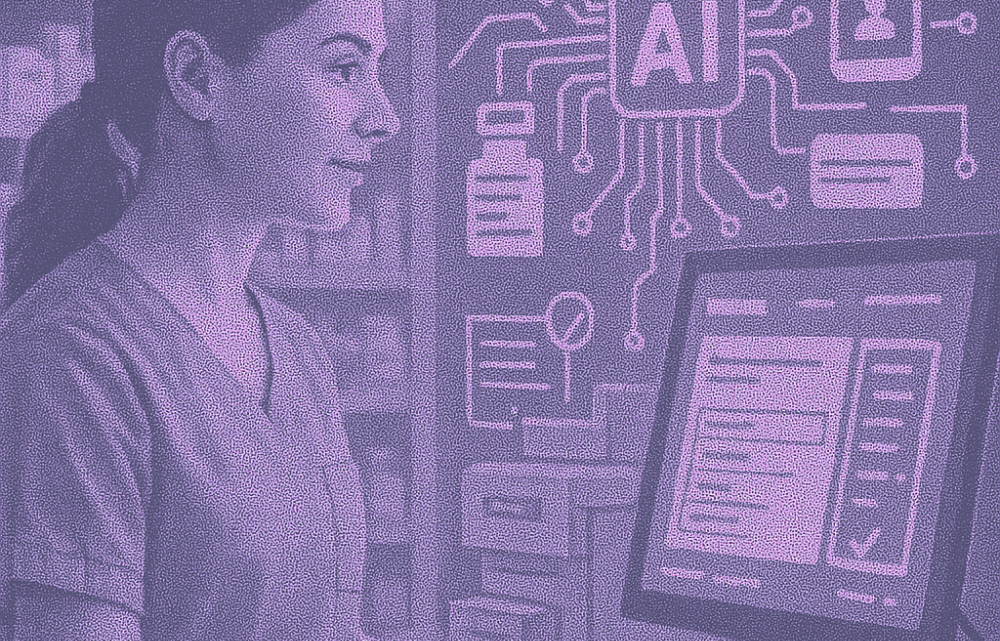
Advances in artificial intelligence, particularly in vision and language processing, have given rise to AI “agents” or bots that can handle pharmacy tasks with speed and precision. These AI agents act as virtual pharmacy technicians, working within your existing software systems just like a human would (no complex new platforms required). They can be trained to navigate pharmacy management system screens, interpret prescription information (text or images), and carry out actions 24/7 without fatigue.
Let’s look at what these AI-powered agents can do in a pharmacy workflow today:
-
Prescription Data Entry: AI agents automatically input electronic prescriptions or even transcribe faxed/handwritten orders into the pharmacy system. They pull key fields (drug, strength, sig, patient info, provider info) with high accuracy, preventing typos and ensuring consistency. This level of throughput simply isn’t attainable with manual entry.
-
Patient Record Updates: Routine updates to patient profiles (new insurance details, address changes, allergy info from patient portals) can be handled by AI. Instead of a technician cutting and pasting data between systems, the AI bot does it instantly and correctly. This keeps records up-to-date without pulling staff away from patient-focused tasks.
-
Refill Management & Insurance Checks: AI tools can automatically handle refill authorization requests, send prior authorization forms, or check plan portals for medication coverage, tasks that otherwise tie up technicians on the phone or website. By automating these processes, prescriptions move to “ready” status faster.
-
Label Printing and Documentation: Generating prescription labels, medication guides, and other documentation is another area ripe for automation. AI agents can trigger label print jobs with the correct information as soon as an order is verified, without a technician clicking through multiple screens. They can also log entries in systems for compliance (e.g., tracking lot numbers or recording counseling notes) in the background.
-
Other Routine Tasks: Modern pharmacy automation even extends to things like inventory management alerts (flagging low stock for reorders), answering common patient questions via AI-driven phone or chat systems, and synchronizing data between pharmacy software and external systems (like eMAR in long-term care facilities). These “digital assistants” tirelessly perform the copy-paste and cross-checking work that would otherwise eat up a technician’s day.
Crucially, all these AI-driven functions integrate into existing workflows. The agents use the same software interfaces as your staff, meaning pharmacies don’t need to overhaul their pharmacy management system (PMS) or train technicians on a whole new application. The AI works behind the scenes, entering a queue of e-prescriptions just as a tech would, or printing labels to your existing printer setup. Technicians can largely carry on with their normal processes, except that now many of the mundane steps happen automatically in the background. One by one, the tedious tasks fall off the technician’s plate.
The impact on accuracy and efficiency is dramatic. By removing the risk of human error in data entry, automation inherently reduces medication errors and omissions. Pharmacy automation systems have been shown to cut error rates and improve patient safety by standardizing how tasks are done. In retail settings, companies like Walgreens and Walmart are leveraging centralized robotic systems to handle the lion’s share of dispensing work, resulting in faster turnaround and fewer errors on a massive scale.
In short, AI is transforming pharmacy workflows by doing the heavy lifting of prescription processing with super-human speed and consistency. This frees up human workers to do what they do best, attending to patients and solving problems that truly require a human touch.
AI as a Partner, Not a Replacement, for Pharmacy Technicians
A looming question on every technician’s mind is, “Will AI take my job?” It’s a valid concern whenever automation enters the workplace. History has shown, however, that in pharmacy automation complements human staff rather than replacing them. In fact, experience so far indicates that empowering technicians with AI leads to expanded roles and greater job satisfaction, not obsolescence.
Think of AI as an extra set of hands for the tedious parts of the job. Automation excels at repetitive, rules-based tasks. It never gets tired of typing or clicking. But what it cannot do is replace the critical thinking, clinical judgment, and compassionate patient care that pharmacy technicians provide every day. In other words, the human element remains irreplaceable in pharmacy practice.
Rather than making technicians redundant, AI is actually elevating the technician’s role. By offloading mundane duties, technicians are free to take on higher-value responsibilities that make full use of their training and talents. We are already seeing the role of pharmacy technicians evolve in response to automation.
Far from losing responsibilities, pharmacy technicians are gaining them in the age of automation. Technicians are now more involved in clinical support, technology management, inventory control, and patient interaction, a broadening of scope that ultimately raises the profile of the profession. All these new or enhanced responsibilities contribute to making the technician’s job more rewarding. When relieved of monotonous tasks, technicians can practice at the top of their skill set. They spend more time helping patients and ensuring the pharmacy runs safely and efficiently.
This shift isn’t just good for patients and business, but for technicians themselves. Pharmacy leadership is finding that technicians who work with automation tend to have higher job satisfaction. One survey noted that technology “clears the way to offer clinical-focused tasks, ultimately improving job satisfaction and minimizing burnout” for pharmacy staff. In short, AI is allowing technicians to do more of what they enjoy and less of what they don’t. The result is often a more engaged, fulfilled workforce.
It’s also worth noting that the demand for pharmacy technicians remains strong even as automation spreads. The U.S. Bureau of Labor Statistics projects steady job growth for pharmacy technicians (~7% growth from 2023 to 2033), which is faster than the average for all occupations. This outlook reflects how the pharmacy technician role is evolving, not disappearing. As automation takes root, technician expertise becomes even more critical to manage advanced workflows and deliver patient care that machines can’t. Far from being phased out, technicians are becoming indispensable liaisons between the technology and the patient.
TJM Labs’ Dual-Expert Model™: Automation with a Human Touch
Implementing AI in pharmacy is not as simple as flipping a switch. Success requires both technical know-how and deep pharmacy domain expertise. That’s why TJM Labs takes a unique Dual-Expert Model™ approach to pharmacy automation projects. Every implementation is led by a pair of experts: one pharmacist and one engineer, working together. This combined team ensures that automation truly supports your staff (rather than causing new headaches) from day one.
A licensed pharmacist from TJM Labs collaborates on the project to embed clinical intelligence into the AI workflows. This pharmacist understands exactly how prescriptions should be processed, what the decision points are for technicians and pharmacists, and where errors commonly occur. They configure the AI agents in line with pharmacy best practices and safety protocols.
Essentially, the pharmacist makes sure the automation behaves like a seasoned technician who knows the ropes and follows all the rules. If there are pharmacy-specific nuances, such as state law differences, special handling for certain medications, or documentation requirements, the pharmacist expert programs those into the system logic. This gives pharmacy leaders confidence that the AI will act in a clinically appropriate manner at all times.
Paired with the pharmacist is a dedicated automation engineer. This engineer’s role is to tailor the AI agents to the pharmacy’s IT environment and workflow specifics. They handle the integration details so that the AI can interface with the pharmacy management software, pharmacy workflows, and hardware (scanners, printers, etc.) seamlessly.
The engineer also designs the AI to be adaptable, recognizing and responding to screen changes or software updates, so the automation doesn’t break when something minor changes. They rigorously test the system under various scenarios to ensure reliability and error-handling are rock solid. In short, the engineer makes sure the technology side of the implementation is bulletproof and customized to your pharmacy’s needs.
TJM Labs’ Dual-Expert Model™ marries these two perspectives into a single, cohesive implementation team. Pharmacist and engineer work hand-in-hand to map out the pharmacy’s workflows, configure the AI, and validate its performance. Before anything goes live, they test the automation in a sandbox environment using real (de-identified) prescription data and typical use cases, verifying that it handles everything correctly, from straightforward refills to complex scripts with multiple directions. This rigorous preparation means that when the AI agents are deployed in your pharmacy, they work correctly from day one, with minimal disruption to operations.
Importantly, this Dual-Expert approach isn’t a one-and-done engagement. TJM Labs continues to provide support as your workflows evolve or new needs arise. If your pharmacy makes changes (say you add a new insurance portal, or start offering a new clinical service), the Dual-Expert team updates the AI agents accordingly.
The result is automation that stays aligned with your business, always under the watchful eye of pharmacy professionals. This collaborative model ensures that the technology truly augments your human team, rather than operating in a silo. It’s automation built with the human touch of experienced pharmacists and savvy engineers who understand that successful pharmacy AI is about empowering people, not replacing them.
Embracing AI as an Ally in Pharmacy
The future of pharmacy operations will be defined by those who successfully integrate artificial intelligence as an ally to the pharmacy workforce. AI automation offers a path to break free from the limitations of manual workflows. No longer must a pharmacy’s output be capped by staffing hours or susceptible to human error rates.
With automation in place, prescription processing can run nearly uninterrupted, scaling up to meet demand while maintaining a high level of accuracy and consistency. For pharmacy teams, this means relief from the relentless grind of data entry and paperwork. It means greater capacity, less burnout, and more time for what truly matters: patient care. As we’ve discussed, AI is already delivering this reality in forward-looking pharmacies today, and its role will only expand in the years ahead.
Crucially, this transformation is not about replacing people, but empowering them. By offloading menial tasks to machines, pharmacies can unleash the full potential of their human talent. Technicians and pharmacists together can devote their energy to clinical decision-making, patient counseling, and optimizing the pharmacy’s services. In an AI-enhanced pharmacy, every team member can operate at the top of their license or skill level, supported by a tireless digital workforce in the background.
The end result is a pharmacy that operates with the efficiency of automation and the empathy and expertise of a human team. Patients receive faster service without sacrificing the personal attention they expect from their pharmacy.
For pharmacy leaders, the message is clear: AI automation is becoming an industry standard and a strategic necessity. Adopting it now is a chance to gain speed, scalability, and resilience in your operations, while making your workplace more attractive for top technician talent. The technology has matured to the point where real-world results, like 25X ROI and dramatic throughput increases, are entirely achievable with the right implementation approach.
TJM Labs has shown that with its Dual-Expert Model™, automation can be deployed in a way that is safe, effective, and embraced by staff. We stand at a turning point where pharmacies that leverage AI can surge ahead, and those that delay may find themselves struggling to keep up.
AI in pharmacy should be viewed as a supportive force for pharmacy teams. It is the means to amplify the capabilities of your technicians, not replace their human touch. The role of the pharmacy technician is evolving, and it’s an exciting evolution towards more impactful and rewarding work.
By welcoming AI into the pharmacy, we create an environment where technicians can shine in higher-value roles, where pharmacists can extend care in new ways, and where the pharmacy as a whole can thrive under increasing demands. The time to embrace that future is now.
FAQs: Pharmacy Technicians and AI Automation
Q: Will AI replace pharmacy technicians?
A: No. In reality, AI is a tool to augment pharmacy technicians, not replace them. Automation takes over repetitive tasks (typing, clicking, filing), but it cannot do everything a technician does. It lacks human judgment, adaptability, and the personal touch. In fact, early adopters have found that automation frees technicians to take on new responsibilities rather than eliminating their jobs. Recent innovations show that rather than cutting technician positions, pharmacies are retraining and elevating techs into more patient-centered and supervisory roles alongside AI systems. Your role will evolve, not disappear, and your expertise remains absolutely critical to safe and effective pharmacy care.
Q: How will my day-to-day role change with AI automation?
A: With AI handling data entry and other rote chores, pharmacy technicians will spend more time on the tasks that truly need a human. Expect to have more direct patient interaction, such as answering patient questions, offering guidance on medication use, and providing service that builds patient trust. You’ll likely be more involved in clinical support, like helping pharmacists with medication therapy management prep or immunization clinics. Additionally, technicians take on oversight of the automation itself: monitoring the AI system’s output, managing exceptions (like prescriptions the AI can’t process), and fine-tuning workflows. Far from reducing what you do, AI will broaden your scope.
Q: Do I need special training or IT skills to work with the AI systems?
A: Not much beyond your current skill set. TJM Labs’ AI agents are designed to plug into the systems you already use, mimicking a human user. This means you won’t have to learn a brand-new software interface or coding to benefit from the automation. The AI will do its work in the background. Of course, there will be a brief orientation when it’s first introduced, so you know how to interact with the system (e.g., checking an AI-entered queue or addressing flags it raises). But this training is straightforward, and TJM Labs’ team will be on hand to guide everyone. In fact, because the AI reduces tedious workload, most technicians find it easy to embrace. The bottom line: you don’t need to be a tech wizard to thrive in an AI-enabled pharmacy; the technology is built to be your helper, not a hurdle you must overcome.
Q: Can we trust the AI to be accurate and safe?
A: Yes, and pharmacies already using AI will tell you it often improves accuracy compared to purely manual processes. TJM Labs’ Dual-Expert Model ensures that each AI workflow is heavily tested by both pharmacists and engineers before going live, so it performs reliably. Once in operation, the AI doesn’t get tired or rushed, meaning it won’t make the kind of typos or oversight errors humans might when busy. Of course, human oversight remains in place for clinical safety. Critical decisions or exceptions still get routed to a pharmacist or technician for review. But the day-to-day processing handled by AI is very consistent. As for data security, the AI agents run within our secure infrastructure or your on-site environment, so all patient data stays protected (HIPAA-compliant). You maintain full control. Many pharmacies actually feel safer with AI because it provides an audit trail and standardized process for each prescription.
Q: How can I stay relevant and excel in an AI-enabled pharmacy?
A: Embrace the technology as a tool and focus on the uniquely human aspects of pharmacy work. Continue developing skills in areas that AI cannot replace, such as patient communication, empathy, and complex problem-solving. If your pharmacy offers training on new systems or wants you to take on a new responsibility (like managing the automation dashboard or a new clinical service), dive in enthusiastically. Essentially, position yourself as the bridge between the technology and the patient. Technicians who can operate comfortably in a high-tech environment and connect with patients will be incredibly valuable.